SAHPRA licences and permits for Medical Devices distribution companies in South Africa
🚨 MANY COMPANIES ARE WAITING YEARS FOR SAHPRA LICENCES 🚨Over the past few years, I have seen many medical device companies struggle with:
❌ Delayed SAHPRA applications
❌ Incomplete submissions
❌ Compliance issues
❌ Lack of guidance on licensing requirements
❌ Long waiting periods with no progress updatesFor businesses in the medical device industry, delays in obtaining a SAHPRA licence can mean:
⚠️ Lost business opportunities
⚠️ Delayed imports and exports
⚠️ Inability to trade legally
⚠️ Financial losses and operational setbacksWhether you are applying for:
✔️ Import licences
✔️ Export licences
✔️ Wholesale licences
✔️ Retail licences
✔️ Medical Device Establishment LicencesProper preparation and compliance management are critical.One of the biggest mistakes companies make is submitting applications without ensuring that all compliance requirements and supporting documentation are correctly aligned with SAHPRA standards from the beginning.With the correct guidance and regulatory support, the process can be significantly streamlined.We assist companies across South Africa with SAHPRA medical distribution licensing and compliance processes with an efficient turnaround approach aimed at reducing unnecessary delays.The medical sector is highly regulated — but with the right assistance, compliance does not have to become a years-long obstacle.📞 WhatsApp: 062 326 4891#SAHPRA #MedicalDevices #HealthcareCompliance #RegulatoryCompliance #MedicalImports #MedicalExports #SouthAfrica #MedicalDistribution #BusinessCompliance #HealthcareIndustry
❌ Delayed SAHPRA applications
❌ Incomplete submissions
❌ Compliance issues
❌ Lack of guidance on licensing requirements
❌ Long waiting periods with no progress updatesFor businesses in the medical device industry, delays in obtaining a SAHPRA licence can mean:
⚠️ Lost business opportunities
⚠️ Delayed imports and exports
⚠️ Inability to trade legally
⚠️ Financial losses and operational setbacksWhether you are applying for:
✔️ Import licences
✔️ Export licences
✔️ Wholesale licences
✔️ Retail licences
✔️ Medical Device Establishment LicencesProper preparation and compliance management are critical.One of the biggest mistakes companies make is submitting applications without ensuring that all compliance requirements and supporting documentation are correctly aligned with SAHPRA standards from the beginning.With the correct guidance and regulatory support, the process can be significantly streamlined.We assist companies across South Africa with SAHPRA medical distribution licensing and compliance processes with an efficient turnaround approach aimed at reducing unnecessary delays.The medical sector is highly regulated — but with the right assistance, compliance does not have to become a years-long obstacle.📞 WhatsApp: 062 326 4891#SAHPRA #MedicalDevices #HealthcareCompliance #RegulatoryCompliance #MedicalImports #MedicalExports #SouthAfrica #MedicalDistribution #BusinessCompliance #HealthcareIndustry

When Employees Lie on Their CVs: The Legal Consequences and Fraud Risks in South Africa
In today’s competitive job market, some job applicants are tempted to exaggerate—or outright falsify—their qualifications, experience, or skills on their CVs. While this may seem like a harmless way to secure employment, the legal implications in South Africa are far more serious than many realise. Misrepresentation on a CV is not just an HR issue—it can amount to fraud, with both disciplinary and criminal consequences.
What Constitutes Lying on a CV?
Common examples include:
- Falsifying qualifications or certificates
- Claiming experience that was never obtained
- Providing incorrect employment history
- Misrepresenting job titles or responsibilities
- Using fake references
Fraud in Terms of South African Law
Under South African law, fraud occurs when a person intentionally makes a misrepresentation that causes actual or potential prejudice to another party. An employee who lies on a CV to secure employment:
- Misrepresents facts to the employer
- Induces the employer to hire them
- Causes financial or operational prejudice to the employer
Relevant Legal Framework
Employers are protected under key legislation such as the:
- Labour Relations Act
- Basic Conditions of Employment Act
Dismissal for Dishonesty
Dishonesty is considered a serious offence in the workplace. In terms of Schedule 8 of the Labour Relations Act:
- Employers may dismiss employees for serious misconduct, including fraud
- The key factor is the breakdown of trust
- Even a single act of dishonesty can justify dismissal
Important Case Law
South African courts have confirmed that lying about qualifications is a dismissible offence. For example:
- SA Post Office Ltd v CCMA
The court upheld dismissal where an employee misrepresented qualifications, emphasising that trust is fundamental to the employment relationship.
Criminal Consequences
Beyond dismissal, employees may face:
- Criminal charges for fraud
- A permanent criminal record
- Difficulty securing future employment
Risk to Employers
Employers also face significant risks when hiring individuals based on false information:
- Financial losses due to incompetence or negligence
- Reputational damage
- Legal liability (especially in regulated industries like construction, mining, and finance)
How Employers Can Protect Themselves
To reduce risk, employers should:
- Conduct thorough background checks
- Verify qualifications with institutions
- Implement strict recruitment policies
- Include honesty clauses in employment contracts
- Take immediate disciplinary action when dishonesty is discovered
Conclusion
Lying on a CV is not a minor issue—it is a serious legal risk that can destroy careers and expose individuals to criminal liability. For employers, the message is clear:
Due diligence is essential, and dishonesty must be dealt with decisively. For employees, the warning is even clearer:
Shortcuts taken at the hiring stage can lead to long-term legal consequences.
Need Assistance?
At Muthliey Ray and Associates, we assist businesses with:
- Labour law compliance
- Disciplinary hearings
- Employment policies
- Legal risk management

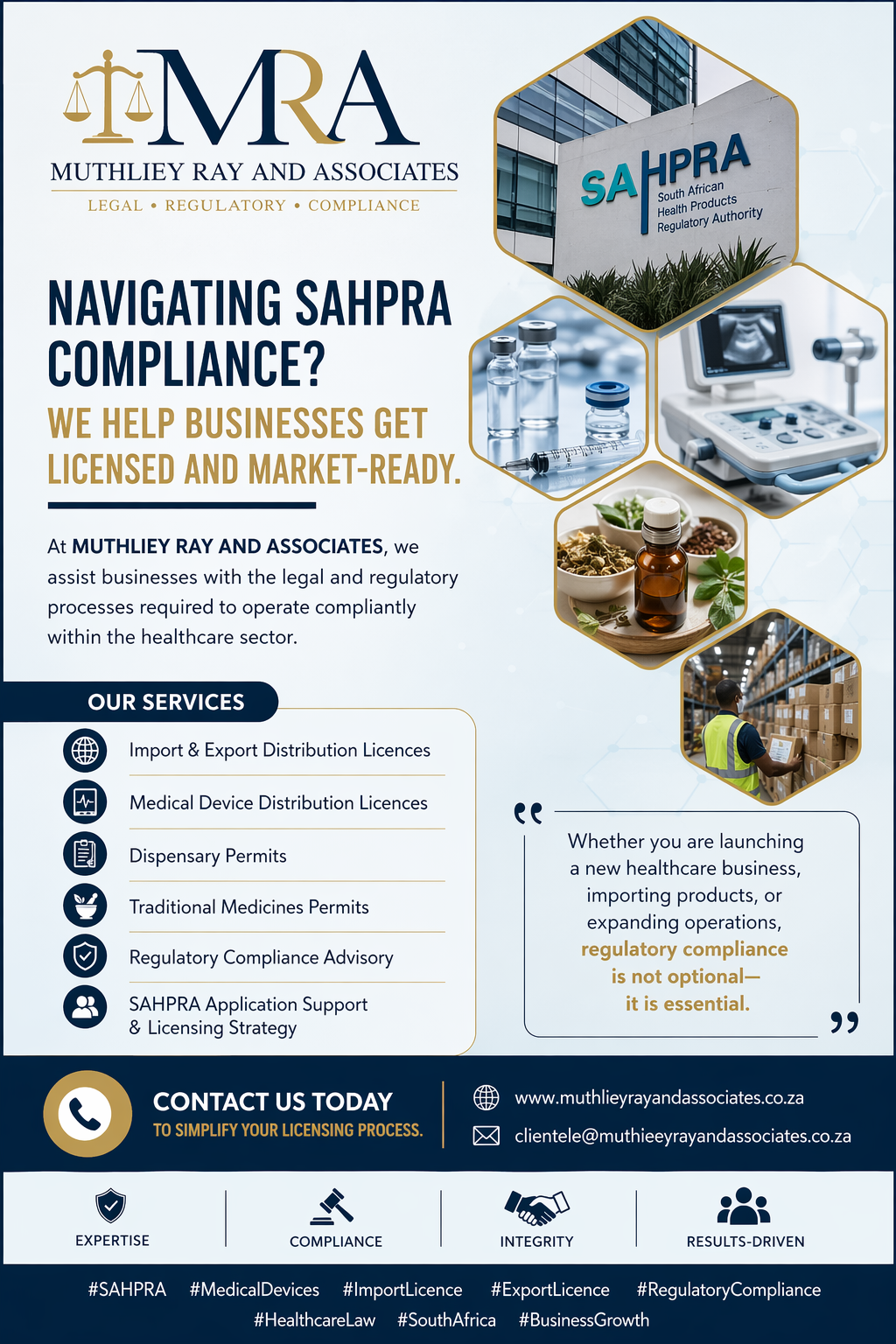
⚖️ Navigating SAHPRA Compliance? We Help Businesses Get Licensed and
⚖️ Navigating SAHPRA Compliance? We Help Businesses Get Licensed and Market-Ready. 🇿🇦The South African Health Products Regulatory Authority plays a critical role in protecting public health by regulating medicines, medical devices, and related health products in South Africa.Their key functions include:✔️ Registration and licensing of medicines and medical devices before market entry
✔️ Licensing manufacturers, importers, wholesalers, and distributors
✔️ Oversight of clinical trial approvals and legal compliance
✔️ Monitoring adverse reactions and product safety after launch
✔️ Regulation of radiation-emitting devices such as X-ray equipment
✔️ Section 21 approvals for urgent access to unregistered medicinesAt MUTHLIEY RAYA AND ASSOCIATES, we assist businesses with the legal and regulatory processes required to operate compliantly within the healthcare sector.🔹 Import & Export Distribution Licences
🔹 Medical Device Distribution Licences
🔹 Dispensary Permits
🔹 Traditional Medicines Permits
🔹 Regulatory Compliance Advisory
🔹 SAHPRA Application Support & Licensing StrategyWhether you are launching a new healthcare business, importing products, or expanding operations, regulatory compliance is not optional—it is essential.📞 Contact us today to simplify your licensing process.
🌐 www.muthlieyrayandassociates.co.za
📧 clientele@muthlieeyrayandassociates.co.za#SAHPRA #MedicalDevices #ImportLicence #ExportLicence #RegulatoryCompliance #HealthcareLaw #SouthAfrica #BusinessGrowth #Licensing #MuthlieyRayaAndAssociates
✔️ Licensing manufacturers, importers, wholesalers, and distributors
✔️ Oversight of clinical trial approvals and legal compliance
✔️ Monitoring adverse reactions and product safety after launch
✔️ Regulation of radiation-emitting devices such as X-ray equipment
✔️ Section 21 approvals for urgent access to unregistered medicinesAt MUTHLIEY RAYA AND ASSOCIATES, we assist businesses with the legal and regulatory processes required to operate compliantly within the healthcare sector.🔹 Import & Export Distribution Licences
🔹 Medical Device Distribution Licences
🔹 Dispensary Permits
🔹 Traditional Medicines Permits
🔹 Regulatory Compliance Advisory
🔹 SAHPRA Application Support & Licensing StrategyWhether you are launching a new healthcare business, importing products, or expanding operations, regulatory compliance is not optional—it is essential.📞 Contact us today to simplify your licensing process.
🌐 www.muthlieyrayandassociates.co.za
📧 clientele@muthlieeyrayandassociates.co.za#SAHPRA #MedicalDevices #ImportLicence #ExportLicence #RegulatoryCompliance #HealthcareLaw #SouthAfrica #BusinessGrowth #Licensing #MuthlieyRayaAndAssociates
Understanding “Illegal Foreigners” in South Africa — And How Legal Support Can Make a Difference
In South Africa, the term “illegal immigrant” is commonly used in everyday conversation. However, in law, the correct term is “illegal foreigner”, as defined in the Immigration Act 13 of 2002.An illegal foreigner is a person who is in the country without valid legal status — whether due to an expired visa, incorrect permit conditions, or lack of documentation. But behind this legal definition lies a more complex reality: many individuals fall into this category not out of intent, but due to administrative delays, lack of access to legal support, or misunderstandings of the system.
⚖️ The Legal Framework
South African law provides clear procedures for dealing with illegal foreigners, including detention and deportation. However, these processes must always align with the fundamental rights protected under the Constitution of South Africa.This means:
🔍 Where Legal Support Becomes Critical
This is where law firms and compliance specialists play a vital role.Rather than viewing the issue purely from an enforcement perspective, there is a growing need for legal regularisation and compliance support, including:✔️ Assisting foreign nationals to regularise their legal status
✔️ Handling overstay appeals and visa applications
✔️ Providing deportation and detention legal assistance
✔️ Supporting asylum and refugee applications under the Refugees Act 130 of 1998
✔️ Conducting identity verification and document tracing
💼 A Compliance Opportunity for Businesses
For employers, this issue is equally important.Hiring individuals without valid documentation can expose businesses to serious legal and financial risks. Proactive steps such as:
🚀 A More Practical Approach
At M R AND ASSOCIATES, we believe the focus should not only be on enforcement, but also on solutions.By assisting individuals to regularise their status and helping businesses remain compliant, we contribute to a system that is both lawful and humane.
📞 Let’s Talk
If you are a foreign national needing assistance with your legal status, or a business seeking compliance support, we’re here to help.📱 062 326 4891
📧 clientele@muthlieyrayandassociates.co.za
#ImmigrationLaw #LegalCompliance #SouthAfrica #illegalimmigrant #dudula #marchandmarch #BusinessCompliance #LegalSupport
⚖️ The Legal Framework
South African law provides clear procedures for dealing with illegal foreigners, including detention and deportation. However, these processes must always align with the fundamental rights protected under the Constitution of South Africa.This means:
- Every individual has the right to fair treatment
- Detention must follow due legal process
- Access to legal representation must be upheld
🔍 Where Legal Support Becomes Critical
This is where law firms and compliance specialists play a vital role.Rather than viewing the issue purely from an enforcement perspective, there is a growing need for legal regularisation and compliance support, including:✔️ Assisting foreign nationals to regularise their legal status
✔️ Handling overstay appeals and visa applications
✔️ Providing deportation and detention legal assistance
✔️ Supporting asylum and refugee applications under the Refugees Act 130 of 1998
✔️ Conducting identity verification and document tracing
💼 A Compliance Opportunity for Businesses
For employers, this issue is equally important.Hiring individuals without valid documentation can expose businesses to serious legal and financial risks. Proactive steps such as:
- Employee verification
- Immigration compliance audits
- Proper documentation processes
🚀 A More Practical Approach
At M R AND ASSOCIATES, we believe the focus should not only be on enforcement, but also on solutions.By assisting individuals to regularise their status and helping businesses remain compliant, we contribute to a system that is both lawful and humane.
📞 Let’s Talk
If you are a foreign national needing assistance with your legal status, or a business seeking compliance support, we’re here to help.📱 062 326 4891
📧 clientele@muthlieyrayandassociates.co.za
#ImmigrationLaw #LegalCompliance #SouthAfrica #illegalimmigrant #dudula #marchandmarch #BusinessCompliance #LegalSupport

Why Deceased Estate Expertise Matters More Than Ever — And Why Choosing the Right Firm Makes All the Difference
When a loved one passes away, families are not only faced with emotional loss — they are also confronted with complex legal, financial, and administrative processes. Navigating a deceased estate can be overwhelming, time-consuming, and, if not handled correctly, costly.This is where experience, precision, and leadership matter.At Muthliey Ray & Associates, we have positioned ourselves as trusted leaders in deceased estate administration by delivering efficient, compassionate, and legally sound solutions when clients need it most.
The Reality of Deceased Estate Administration
Administering a deceased estate involves far more than paperwork. It requires:• Reporting the estate to the Master of the High Court
• Identifying and securing assets
• Settling debts and liabilities
• Managing disputes between beneficiaries
• Preparing liquidation and distribution accounts
• Handling property transfers
• Finalising tax matters
• Distributing inheritances lawfullyEach step requires legal expertise, attention to detail, and strategic coordination. A delay or error at any stage can prolong the process for months — sometimes even years.
What Sets Us Apart
At Muthliey Ray & Associates, we combine legal excellence with practical efficiency. Our approach focuses on:✅ Fast and efficient estate reporting
✅ Clear communication with families and beneficiaries
✅ Strategic handling of complex estates
✅ Dispute resolution and conflict management
✅ Property transfers and conveyancing under one roof
✅ Professional, compassionate client careWe understand that behind every estate is a family seeking closure. Our role is not only to administer estates — but to provide certainty, clarity, and peace of mind.
Why Leadership in This Space Matters
The demand for experienced deceased estate practitioners is growing. With increasing asset complexity, blended families, and cross-border considerations, expertise is no longer optional — it is essential.Our team has built a reputation for:• Professional integrity
• Efficient turnaround times
• Practical legal solutions
• Trusted advisory relationshipsWe don't just handle deceased estates — we lead in delivering outcomes that protect families and preserve legacies.
Supporting Families. Protecting Legacies.
Whether the estate is straightforward or complex, our commitment remains the same: to provide leadership, reliability, and exceptional service at every step.If you require assistance with a deceased estate, estate planning, or wills, our team is ready to assist.Muthliey Ray & Associates
Leaders in Deceased Estate Administration
Professional. Compassionate. Efficient.#DeceasedEstates #EstateAdministration #WillsAndEstates #LegalServices #LawFirm #MuthlieyRayAndAssociates #EstatePlanning #LegalLeadership #SouthAfricaLaw #Attorneys
The Reality of Deceased Estate Administration
Administering a deceased estate involves far more than paperwork. It requires:• Reporting the estate to the Master of the High Court
• Identifying and securing assets
• Settling debts and liabilities
• Managing disputes between beneficiaries
• Preparing liquidation and distribution accounts
• Handling property transfers
• Finalising tax matters
• Distributing inheritances lawfullyEach step requires legal expertise, attention to detail, and strategic coordination. A delay or error at any stage can prolong the process for months — sometimes even years.
What Sets Us Apart
At Muthliey Ray & Associates, we combine legal excellence with practical efficiency. Our approach focuses on:✅ Fast and efficient estate reporting
✅ Clear communication with families and beneficiaries
✅ Strategic handling of complex estates
✅ Dispute resolution and conflict management
✅ Property transfers and conveyancing under one roof
✅ Professional, compassionate client careWe understand that behind every estate is a family seeking closure. Our role is not only to administer estates — but to provide certainty, clarity, and peace of mind.
Why Leadership in This Space Matters
The demand for experienced deceased estate practitioners is growing. With increasing asset complexity, blended families, and cross-border considerations, expertise is no longer optional — it is essential.Our team has built a reputation for:• Professional integrity
• Efficient turnaround times
• Practical legal solutions
• Trusted advisory relationshipsWe don't just handle deceased estates — we lead in delivering outcomes that protect families and preserve legacies.
Supporting Families. Protecting Legacies.
Whether the estate is straightforward or complex, our commitment remains the same: to provide leadership, reliability, and exceptional service at every step.If you require assistance with a deceased estate, estate planning, or wills, our team is ready to assist.Muthliey Ray & Associates
Leaders in Deceased Estate Administration
Professional. Compassionate. Efficient.#DeceasedEstates #EstateAdministration #WillsAndEstates #LegalServices #LawFirm #MuthlieyRayAndAssociates #EstatePlanning #LegalLeadership #SouthAfricaLaw #Attorneys
Sed pede ullamcorper amet ullamcorper primis, nam pretium suspendisse neque, a phasellus sit pulvinar vel integer.
INSOLVENCY & BUSINESS RESCUE
Insolvency & Business Rescue: Saving Businesses. Protecting Futures.In today’s unpredictable economic climate, businesses face increasing financial pressure. Cash flow constraints, rising operational costs, and economic uncertainty can quickly place even well-run businesses in financial distress.However, financial distress does not have to mean the end of a business.At Muthliey Ray & Associates, we specialise in Insolvency and Business Rescue, helping companies navigate financial challenges, protect stakeholders, and where possible, restore businesses to profitability.
Understanding Business Rescue
Business rescue is designed to give financially distressed companies an opportunity to restructure and recover rather than close down. It offers:• Temporary protection from creditors
• Restructuring of debts
• Negotiated payment arrangements
• Operational restructuring
• Preservation of jobs and business valueWhen implemented correctly and timeously, business rescue can transform a struggling business into a sustainable and profitable enterprise.
When Should You Consider Business Rescue?
Business rescue may be appropriate when:• Your business struggles to pay creditors
• Cash flow is under pressure
• Legal action from creditors is imminent
• The business is technically insolvent
• The company needs restructuring to surviveEarly intervention is key. The sooner professional advice is sought, the greater the chances of saving the business.
Insolvency Services We Offer
At Muthliey Ray & Associates, we provide:✅ Business Rescue Advisory
✅ Voluntary Liquidations
✅ Compulsory Liquidations
✅ Creditor Negotiations
✅ Debt Restructuring
✅ Director Advisory & Compliance
✅ Distressed Business Advisory
✅ Stakeholder Management
Why Choose Us?
We understand that insolvency matters require urgency, strategy, and discretion. Our team provides:• Practical commercial solutions
• Strategic legal guidance
• Fast and efficient turnaround
• Confidential and professional handling
• Clear communication throughout the processOur goal is simple: Save viable businesses where possible — and manage insolvency efficiently where necessary.
Leadership in Insolvency & Business Rescue
At Muthliey Ray & Associates, we combine legal expertise with commercial understanding. We work closely with directors, creditors, and stakeholders to achieve the best possible outcomes.Whether you're a business owner, director, or creditor — we are ready to assist.Muthliey Ray & Associates
Insolvency & Business Rescue Specialists
Strategic. Professional. Results-Driven.#BusinessRescue #Insolvency #BusinessRestructuring #CorporateLaw #LegalServices #MuthlieyRayAndAssociates #BusinessSupport #FinancialDistress #CorporateAdvisory #SouthAfricaBusiness
Understanding Business Rescue
Business rescue is designed to give financially distressed companies an opportunity to restructure and recover rather than close down. It offers:• Temporary protection from creditors
• Restructuring of debts
• Negotiated payment arrangements
• Operational restructuring
• Preservation of jobs and business valueWhen implemented correctly and timeously, business rescue can transform a struggling business into a sustainable and profitable enterprise.
When Should You Consider Business Rescue?
Business rescue may be appropriate when:• Your business struggles to pay creditors
• Cash flow is under pressure
• Legal action from creditors is imminent
• The business is technically insolvent
• The company needs restructuring to surviveEarly intervention is key. The sooner professional advice is sought, the greater the chances of saving the business.
Insolvency Services We Offer
At Muthliey Ray & Associates, we provide:✅ Business Rescue Advisory
✅ Voluntary Liquidations
✅ Compulsory Liquidations
✅ Creditor Negotiations
✅ Debt Restructuring
✅ Director Advisory & Compliance
✅ Distressed Business Advisory
✅ Stakeholder Management
Why Choose Us?
We understand that insolvency matters require urgency, strategy, and discretion. Our team provides:• Practical commercial solutions
• Strategic legal guidance
• Fast and efficient turnaround
• Confidential and professional handling
• Clear communication throughout the processOur goal is simple: Save viable businesses where possible — and manage insolvency efficiently where necessary.
Leadership in Insolvency & Business Rescue
At Muthliey Ray & Associates, we combine legal expertise with commercial understanding. We work closely with directors, creditors, and stakeholders to achieve the best possible outcomes.Whether you're a business owner, director, or creditor — we are ready to assist.Muthliey Ray & Associates
Insolvency & Business Rescue Specialists
Strategic. Professional. Results-Driven.#BusinessRescue #Insolvency #BusinessRestructuring #CorporateLaw #LegalServices #MuthlieyRayAndAssociates #BusinessSupport #FinancialDistress #CorporateAdvisory #SouthAfricaBusiness
Why Many CIDB Applications Are Being Rejected — And What Contractors Can Do
Across the construction industry, we are seeing a growing trend: Many CIDB applications are being rejected, placed under appeal, or flagged for investigation. For contractors, this is more than just paperwork. A rejected or delayed CIDB grading can mean:
• Lost tender opportunities
• Project delays
• Cash flow pressure
• Reputational risk Why is this happening? In most cases, the problem is not the contractor’s experience — it’s the documentation and compliance requirements, such as:
• Incorrect or incomplete financials
• Insufficient proof of completed projects
• Mismatched turnover and grading level
• Missing supporting documents
• Errors in application forms
• Compliance concerns flagged by CIDB CIDB has also increased its verification and audit processes, which means applications are now scrutinised more closely than before. The good news? Many of these issues can be fixed. At Muthliey Ray & Associates, we assist contractors with:
✔ New CIDB applications
✔ Grade upgrades
✔ Appeals and reconsiderations
✔ Responding to CIDB queries or investigations
✔ Full compliance file preparation Our goal is simple:
To help you submit a strong, compliant application that gives your business the best chance of approval. If your application has been rejected, delayed, or placed under review — don’t wait until you lose opportunities. Let’s fix it properly. 📩 clientele@muthlieyrayandassociates.co.za
📞 074 746 0346 #CIDB #ConstructionSA #ContractorsSA #TenderReady #BusinessCompliance #ConstructionIndustry #InfrastructureSA #BuildingSouthAfrica #CIDBUpgrade #ConstructionBusiness
• Lost tender opportunities
• Project delays
• Cash flow pressure
• Reputational risk Why is this happening? In most cases, the problem is not the contractor’s experience — it’s the documentation and compliance requirements, such as:
• Incorrect or incomplete financials
• Insufficient proof of completed projects
• Mismatched turnover and grading level
• Missing supporting documents
• Errors in application forms
• Compliance concerns flagged by CIDB CIDB has also increased its verification and audit processes, which means applications are now scrutinised more closely than before. The good news? Many of these issues can be fixed. At Muthliey Ray & Associates, we assist contractors with:
✔ New CIDB applications
✔ Grade upgrades
✔ Appeals and reconsiderations
✔ Responding to CIDB queries or investigations
✔ Full compliance file preparation Our goal is simple:
To help you submit a strong, compliant application that gives your business the best chance of approval. If your application has been rejected, delayed, or placed under review — don’t wait until you lose opportunities. Let’s fix it properly. 📩 clientele@muthlieyrayandassociates.co.za
📞 074 746 0346 #CIDB #ConstructionSA #ContractorsSA #TenderReady #BusinessCompliance #ConstructionIndustry #InfrastructureSA #BuildingSouthAfrica #CIDBUpgrade #ConstructionBusiness

BREAKING NEWS: National Minimum Wage Increased to R30.23 per hour.
The Minister of Employment and Labour has amended the national minimum wage rate. The amendment comes into operation on 1 March 2026, and the new national minimum wage rate will be R30.23 for each ordinary hour worked..
Arbitration: A Practical and Effective Alternative to Court Litigation
In an environment where court rolls are congested and litigation can be time-consuming and costly, arbitration has become an increasingly important dispute-resolution mechanism for individuals and businesses alike. At Muthliey Ray & Associates, arbitration forms part of our strategic approach to resolving disputes efficiently, confidentially, and with finality.
What is Arbitration?
Arbitration is a private dispute resolution process where parties agree to submit their dispute to an independent arbitrator rather than a court. The arbitrator considers the evidence and legal arguments and issues a binding decision, known as an arbitration award. Unlike court proceedings, arbitration is less formal, more flexible, and tailored to the needs of the parties involved.
Why Arbitration Is Used
Arbitration is often chosen for the following reasons: 1. Speed and Efficiency
Court cases can take years to conclude. Arbitration allows disputes to be resolved within agreed timelines, significantly reducing delays. 2. Confidentiality
Unlike court proceedings, which are generally public, arbitration is private. This is especially valuable for commercial entities, professionals, and family-related disputes where confidentiality is critical. 3. Expertise of the Arbitrator
Parties may appoint an arbitrator with specific expertise relevant to the dispute, such as commercial contracts, construction, labour, or technical matters. 4. Cost Control
While arbitration involves professional fees, the streamlined process often results in lower overall costs compared to prolonged litigation. 5. Finality
Arbitration awards are binding and enforceable, with limited grounds for appeal. This provides certainty and closure for the parties.
Where Arbitration Is Conducted
Arbitration is conducted at a venue agreed upon by the parties, which may include:
What Arbitration Helps With
Arbitration is commonly used in disputes involving:
How We Approach Arbitration at Muthliey Ray & Associates
Our approach to arbitration is:
Conclusion
Arbitration is not merely an alternative to litigation — it is often the preferred route for resolving disputes where speed, confidentiality, and certainty are paramount. For businesses and individuals seeking effective dispute resolution without the burdens of traditional court proceedings, arbitration provides a practical and powerful solution. If you want, I can next:
What is Arbitration?
Arbitration is a private dispute resolution process where parties agree to submit their dispute to an independent arbitrator rather than a court. The arbitrator considers the evidence and legal arguments and issues a binding decision, known as an arbitration award. Unlike court proceedings, arbitration is less formal, more flexible, and tailored to the needs of the parties involved.
Why Arbitration Is Used
Arbitration is often chosen for the following reasons: 1. Speed and Efficiency
Court cases can take years to conclude. Arbitration allows disputes to be resolved within agreed timelines, significantly reducing delays. 2. Confidentiality
Unlike court proceedings, which are generally public, arbitration is private. This is especially valuable for commercial entities, professionals, and family-related disputes where confidentiality is critical. 3. Expertise of the Arbitrator
Parties may appoint an arbitrator with specific expertise relevant to the dispute, such as commercial contracts, construction, labour, or technical matters. 4. Cost Control
While arbitration involves professional fees, the streamlined process often results in lower overall costs compared to prolonged litigation. 5. Finality
Arbitration awards are binding and enforceable, with limited grounds for appeal. This provides certainty and closure for the parties.
Where Arbitration Is Conducted
Arbitration is conducted at a venue agreed upon by the parties, which may include:
- Arbitration centres
- Legal offices
- Boardrooms
- Virtual platforms (where appropriate)
What Arbitration Helps With
Arbitration is commonly used in disputes involving:
- Commercial and contractual disagreements
- Construction and engineering disputes
- Shareholder and partnership conflicts
- Employment and labour-related disputes
- Professional service disputes
How We Approach Arbitration at Muthliey Ray & Associates
Our approach to arbitration is:
- Strategic – assessing whether arbitration is the most suitable forum for the dispute
- Client-focused – tailoring the process to the nature and complexity of the matter
- Outcome-driven – prioritising efficiency, enforceability, and practical solutions
Conclusion
Arbitration is not merely an alternative to litigation — it is often the preferred route for resolving disputes where speed, confidentiality, and certainty are paramount. For businesses and individuals seeking effective dispute resolution without the burdens of traditional court proceedings, arbitration provides a practical and powerful solution. If you want, I can next:
- Shorten this into a LinkedIn carousel or post
- Rewrite it specifically for commercial / construction arbitration
- Add a soft call-to-action for directors and businesses
- Align it with your brand tone and services
Your WhatsApp message may be a contract. Yes, a binding one.
Your WhatsApp message may be a contract. Yes, a binding one.
A recent High Court decision in Ochiel v Okoth (HCSCA No. E002 of 2025) is a timely reminder that contracts are no longer confined to neatly signed documents and company seals
In this case, the court upheld an agreement that was never reduced into a formal written contract. Instead, the existence and terms of the contract were inferred from:
1.WhatsApp messages
2.SMS correspondence
3.Conduct of the parties including partial payment and delivery of goods
The court was unequivocal: contracts can be inferred from digital communication and conduct, provided the essential elements exist offer, acceptance, consideration and capacity.
A “meeting of minds” does not require a PDF attachment or a signature block. It can happen in a chat thread.
What stands out for me is the court’s firm stance on accountability in the digital age. Once parties exchange messages that clearly show agreement on price, duration and obligations and act on them, the law will step in to enforce those obligations. Courts will not rescue parties from “informal” deals simply because they later regret the terms.
The broader lesson for individuals and corporates alike is uncomfortable but necessary:
-WhatsApp is not “casual” when business is being discussed
-Silence, promises to pay and partial payments can speak loudly in court
-Courts will enforce digital bargains unless illegality, fraud or unconscionability is proven
In an era where business moves at the speed of a voice note, this decision reinforces a simple truth: how you communicate matters just as much as what you communicate.
If you are negotiating commercially even with friends assume your messages may one day be read aloud in court.
A recent High Court decision in Ochiel v Okoth (HCSCA No. E002 of 2025) is a timely reminder that contracts are no longer confined to neatly signed documents and company seals
In this case, the court upheld an agreement that was never reduced into a formal written contract. Instead, the existence and terms of the contract were inferred from:
1.WhatsApp messages
2.SMS correspondence
3.Conduct of the parties including partial payment and delivery of goods
The court was unequivocal: contracts can be inferred from digital communication and conduct, provided the essential elements exist offer, acceptance, consideration and capacity.
A “meeting of minds” does not require a PDF attachment or a signature block. It can happen in a chat thread.
What stands out for me is the court’s firm stance on accountability in the digital age. Once parties exchange messages that clearly show agreement on price, duration and obligations and act on them, the law will step in to enforce those obligations. Courts will not rescue parties from “informal” deals simply because they later regret the terms.
The broader lesson for individuals and corporates alike is uncomfortable but necessary:
-WhatsApp is not “casual” when business is being discussed
-Silence, promises to pay and partial payments can speak loudly in court
-Courts will enforce digital bargains unless illegality, fraud or unconscionability is proven
In an era where business moves at the speed of a voice note, this decision reinforces a simple truth: how you communicate matters just as much as what you communicate.
If you are negotiating commercially even with friends assume your messages may one day be read aloud in court.
Gross Negligence: When “I Didn’t Sign It” Isn’t a Defence
The Labour Court has made it clear 👇
🔹 Gross negligence goes beyond mistakes – it’s a reckless or conscious disregard of duty
🔹 Assessed in context – senior role, experience, policies and risk exposure matter
🔹 Inaction counts – failing to follow up, escalate or fix known issues is negligence
🔹 Actual or potential loss to the employer strengthens the case
🔹 Authority excuses don’t wash – responsibility includes ensuring work is done, not just doing it yourself
⚖️ Bottom line:
Where a senior employee knowingly fails to act over time, exposes the employer to risk, and shows indifference — dismissal for gross negligence can be fair.
📌 Gross negligence = a serious breach of trust.
How Construction Law Works – And How We Support Clients
Construction law governs the legal relationships between employers, contractors, subcontractors, and professionals involved in construction projects. It regulates contracts, payment obligations, delays, variations, safety compliance, and dispute resolution. In practice, construction disputes often arise from:
- Poorly drafted or unsigned contracts
- Payment delays and non-payment
- Project delays and extension of time claims
- Scope changes and variations
- Termination of contracts
- Health and safety compliance issues
How we assist construction clients
At Muthliey Ray & Associates, we assist construction clients by:
- Drafting and reviewing construction contracts
- Advising on payment, variation, and delay claims
- Assisting with dispute resolution, including adjudication and arbitration
- Supporting clients in enforcing contractual rights
- Advising directors on legal risk and compliance during projects
Final note for directors and contractors
Construction law is not only about disputes — it is about risk management and project protection.
Clients who seek legal guidance early are better positioned to avoid costly delays and claims.
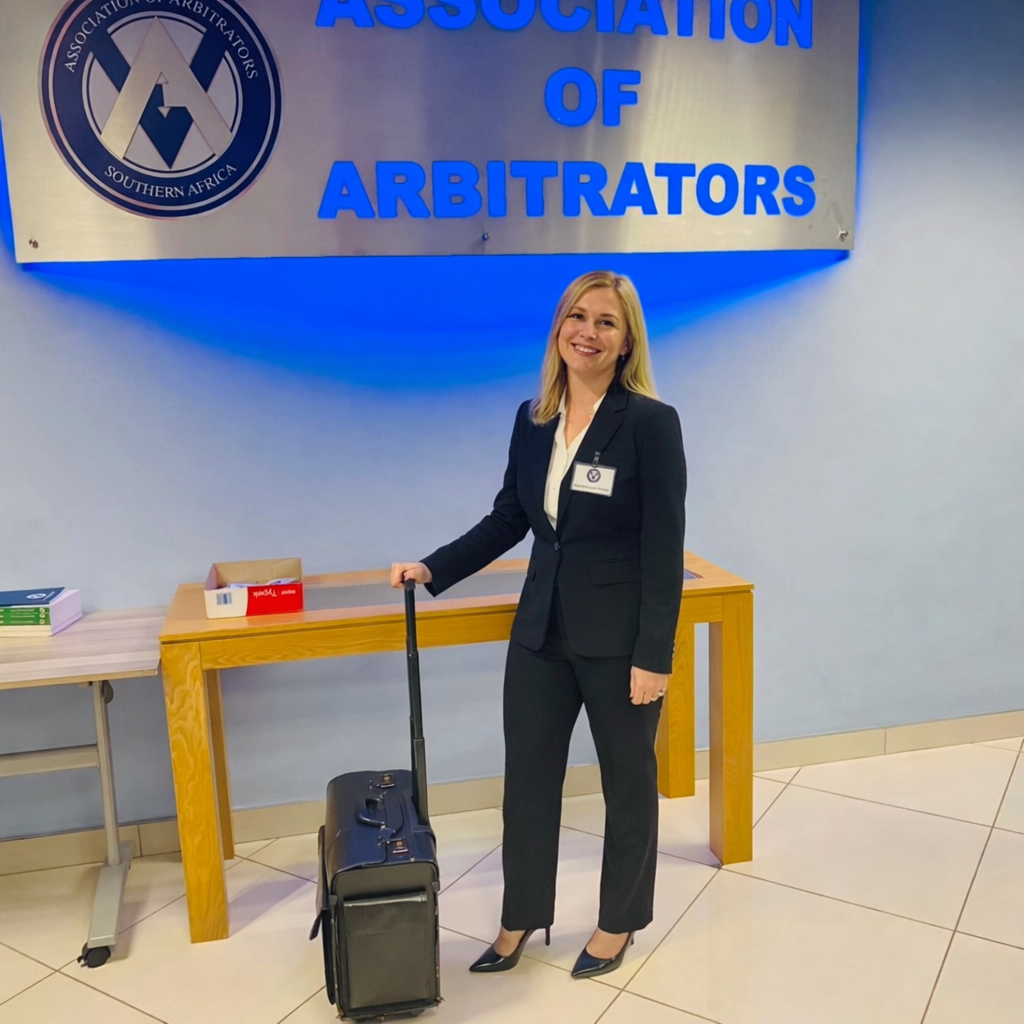

Navigating the Master of the High Court & Deceased Estates — How We Help Families Get It Right
The death of a loved one is already an emotionally overwhelming experience. Unfortunately, it is often followed by a complex legal process involving the Master of the High Court and the administration of the deceased estate. For many families, this process is confusing, time-consuming, and stressful — especially when delays or disputes arise. At Muthliey Ray and Associates, we step in to simplify this process, protect beneficiaries, and ensure estates are administered lawfully, efficiently, and with dignity.
What Is the Role of the Master of the High Court?
The Master of the High Court supervises the administration of deceased estates in South Africa. This includes:
- Appointing executors
- Overseeing the distribution of assets
- Ensuring compliance with the Administration of Estates Act
- Protecting the interests of heirs and creditors
How We Assist with Deceased Estates
We provide end-to-end legal support, whether the estate is small, complex, testate (with a will), or intestate (without a will). Our services include: ✔️ Reporting deceased estates to the Master of the High Court
✔️ Drafting and lodging all required documents, including inventories and affidavits
✔️ Assisting executors with letters of executorship or authority
✔️ Interpreting and enforcing wills
✔️ Handling intestate succession matters
✔️ Resolving disputes between heirs and beneficiaries
✔️ Ensuring lawful distribution of assets
✔️ Finalising estates efficiently to avoid prolonged delays
Why Professional Assistance Matters
Many estates are delayed for months — sometimes years — due to:
- Incorrect documentation
- Non-compliance with Master’s directives
- Executor inexperience
- Family disputes
- Missing or unclear wills
- Compliance is achieved from the outset
- Executors fulfil their duties correctly
- Beneficiaries receive what they are legally entitled to
- Families avoid unnecessary conflict and emotional strain
Our Approach: Legal. Compliance. Sorted.
We understand that deceased estate matters are not just legal issues — they affect real people, real families, and real futures. Our approach is professional, compassionate, and solution-driven. Whether you are:
- An executor needing guidance
- A beneficiary seeking clarity
- A family dealing with an unreported estate
- Or facing delays at the Master’s office
Cannabis Law in South Africa: From the Prince Judgment to the Emerging Cannabusiness Economy
In 2018, South Africa’s Constitutional Court delivered a landmark judgment in Minister of Justice and Constitutional Development and Others v Prince; National Director of Public Prosecutions and Others v Rubin; National Director of Public Prosecutions and Others v Acton and Others [2018] ZACC 30 (“the Prince Judgment”). This decision fundamentally reshaped South Africa’s cannabis law landscape by decriminalising the private cultivation, possession, and use of cannabis by adults for personal consumption. Beyond its constitutional significance, the judgment marked the beginning of a broader shift in public perception—gradually eroding long-standing stigma and opening the door to what is now widely regarded as a multi-billion Rand economic opportunity.
The Prince Judgment: What the Law Allows (and What It Doesn’t)
The Constitutional Court found that sections of the Drugs and Drug Trafficking Act 140 of 1992 and the Medicines and Related Substances Act 101 of 1965 were unconstitutional to the extent that they criminalised private cannabis use by adults. Importantly, the Court made it clear that:
Private Cannabis Clubs: Operating in a Legal Grey Area
Private Cannabis Clubs have emerged as a response to the gap between constitutional rights and commercial prohibition. These models typically rely on:
Medicinal Cannabis: A Regulated Pathway to Commercialisation
Positive regulatory developments have occurred in the medicinal cannabis sector. The South African Health Products Regulatory Authority (SAHPRA) now facilitates licensing for:
Industrial Hemp: Growing Regulatory Certainty
The industrial hemp sector has also seen encouraging progress. The Minister of Agriculture, Land Reform and Rural Development has been empowered to regulate hemp cultivation through:
How We Assist Cannabusinesses
Whether operating in:
Preparing for the Industry’s Inevitable Expansion
While certain cannabusiness models may not yet be fully lawful or commercially viable, the industry is undeniably moving toward broader regulation and formalisation. The key is strategic preparation. By building compliant structures, protecting intellectual property, and positioning brands early, businesses can place themselves ahead of the curve—ready to scale when legislative reform catches up with market demand. With our in-depth understanding of cannabis law, regulatory frameworks, and sector dynamics, we assist our clients in shaping a credible, compliant, and future-ready presence in South Africa’s evolving cannabis economy.
The Prince Judgment: What the Law Allows (and What It Doesn’t)
The Constitutional Court found that sections of the Drugs and Drug Trafficking Act 140 of 1992 and the Medicines and Related Substances Act 101 of 1965 were unconstitutional to the extent that they criminalised private cannabis use by adults. Importantly, the Court made it clear that:
- Cannabis use, possession, and cultivation are lawful only in private
- The right applies only to adults
- Commercial trading remains illegal, unless authorised by law
- The State retains the power to regulate public health and safety
Private Cannabis Clubs: Operating in a Legal Grey Area
Private Cannabis Clubs have emerged as a response to the gap between constitutional rights and commercial prohibition. These models typically rely on:
- Collective cultivation on behalf of members
- Non-profit or cost-recovery structures
- Strict membership rules and private access
Medicinal Cannabis: A Regulated Pathway to Commercialisation
Positive regulatory developments have occurred in the medicinal cannabis sector. The South African Health Products Regulatory Authority (SAHPRA) now facilitates licensing for:
- Cultivation of medicinal cannabis
- Manufacturing and processing
- Distribution and export of medicinal cannabis products
Industrial Hemp: Growing Regulatory Certainty
The industrial hemp sector has also seen encouraging progress. The Minister of Agriculture, Land Reform and Rural Development has been empowered to regulate hemp cultivation through:
- Registration requirements
- Permit systems
- THC threshold compliance
How We Assist Cannabusinesses
Whether operating in:
- The private cannabis space
- The medicinal cannabis industry
- The industrial hemp sector
- Legal feasibility assessments
- Regulatory compliance advice
- Licensing and permit applications
- Business model structuring
- Risk mitigation and strategic positioning
Preparing for the Industry’s Inevitable Expansion
While certain cannabusiness models may not yet be fully lawful or commercially viable, the industry is undeniably moving toward broader regulation and formalisation. The key is strategic preparation. By building compliant structures, protecting intellectual property, and positioning brands early, businesses can place themselves ahead of the curve—ready to scale when legislative reform catches up with market demand. With our in-depth understanding of cannabis law, regulatory frameworks, and sector dynamics, we assist our clients in shaping a credible, compliant, and future-ready presence in South Africa’s evolving cannabis economy.
The constitutional court verdict on Customary marraiges and antenuptial contracts
I wish our traditional leaders could obtain legal advice and challenge the current law in relation to Customary Marriages. We can't allow our customs amd traditions to be disregarded like this. NgesiZulu, kuyacelwa, kulotsholwe, kukhehlwe, kwembeswe, umbondo, bese kugcagcwa, umakoti athelwe ngenyongo, bese kuyima kuthiwe senishadile noma uMakoti usephelele. You can sign the Western Law Antinuptial Contract (ANC) before ilobolo, kodwa ngeSintu ANISHADILE, LOWOMSHADO AWAZIWA!
Khona okunye okwenziwayo, kuhlukane ngezigodi, but the aforementioned are common across Amanguni. Kanti yini Ingoduso, uma usuke usushadile ngokulobola nje, yini umlobokazi etc. Uma impela ilobolo lisho umshado, then we might as well agree that there is NO NEED for all these other things done after ilobolo, noma lika R5000, kusuke sekuqediwe senishadile. Ake asukume Amakhosi kanye Nendlunkulu.
These are the real issues our traditional leaders should get involved in and resolve. Baphi amaholi bendabuko ezintweni ezibaluleke ngempela njengalena ye Customary Marriage and recent court rulings.
Khona okunye okwenziwayo, kuhlukane ngezigodi, but the aforementioned are common across Amanguni. Kanti yini Ingoduso, uma usuke usushadile ngokulobola nje, yini umlobokazi etc. Uma impela ilobolo lisho umshado, then we might as well agree that there is NO NEED for all these other things done after ilobolo, noma lika R5000, kusuke sekuqediwe senishadile. Ake asukume Amakhosi kanye Nendlunkulu.
These are the real issues our traditional leaders should get involved in and resolve. Baphi amaholi bendabuko ezintweni ezibaluleke ngempela njengalena ye Customary Marriage and recent court rulings.
Disciplianary Hearing
A while ago, I had the privilege and pressure of handling my very first disciplinary hearing appeal. To say it was exhilarating would be an understatement. It was a moment that tested not just my legal knowledge but also my ability to think critically, analyze facts and make a decision that could change someone’s life.
In a country where jobs are scarce the gravity of deciding whether someone remains employed or not weighed heavily on me. The reality is that behind every disciplinary case is a person with responsibilities, a family to feed and a future that could be altered with the stroke of a pen. But at the same time, companies have policies, standards and the right to maintain discipline in the workplace. Striking that balance between fairness, company policies and labour law was both thrilling and terrifying.
What stood out most was the power of legal interpretation, how the same set of facts can be viewed differently depending on the lens through which you analyze them. Every word in the company policy mattered. Every precedent in labour law had weight. And as much as the case was about facts and law, it also came down to logic, fairness and sound reasoning.
This experience was a huge learning curve for me, one that reinforced why I love being in this profession. The law is not just about statutes and regulations it’s about people, justice and making informed decisions that have real-life consequences. I walked away from this experience wiser, sharper and more prepared for the next challenge that comes my way.
Here’s to growing, learning and evolving in the legal space! ⚖️
hashtag#LegalJourney hashtag#LabourLaw hashtag#DisciplinaryHearing hashtag#Growth hashtag#Justice
In a country where jobs are scarce the gravity of deciding whether someone remains employed or not weighed heavily on me. The reality is that behind every disciplinary case is a person with responsibilities, a family to feed and a future that could be altered with the stroke of a pen. But at the same time, companies have policies, standards and the right to maintain discipline in the workplace. Striking that balance between fairness, company policies and labour law was both thrilling and terrifying.
What stood out most was the power of legal interpretation, how the same set of facts can be viewed differently depending on the lens through which you analyze them. Every word in the company policy mattered. Every precedent in labour law had weight. And as much as the case was about facts and law, it also came down to logic, fairness and sound reasoning.
This experience was a huge learning curve for me, one that reinforced why I love being in this profession. The law is not just about statutes and regulations it’s about people, justice and making informed decisions that have real-life consequences. I walked away from this experience wiser, sharper and more prepared for the next challenge that comes my way.
Here’s to growing, learning and evolving in the legal space! ⚖️
hashtag#LegalJourney hashtag#LabourLaw hashtag#DisciplinaryHearing hashtag#Growth hashtag#Justice

Top 5 Things to Consider Before Getting a Divorce:
Divorce can be a life-altering decision. Before taking the next step, carefully consider the following crucial factors:
1. Financial Implications: - How will assets, debts and financial responsibilities be divided? Will you need to adjust your lifestyle or budget?
2. Children's primary care and residence, Access and Support:- What arrangement will be in the best interest of your children? How will primary care and residence, access and child support be determined?
3. Emotional Preparedness:- Are you and your family emotionally prepared for the challenges of divorce? Consider seeking counseling or support groups to help navigate this difficult time.
4. Property and Asset Division:- How will shared assets, such as property, pensions, businesses and investments be valued and divided? Are there any specific assets you'd like to retain or protect?
5. Legal Rights and Obligations:- What are your rights and responsibilities regarding spousal support, child's primary care and residence and other legal matters?
Understanding your legal position can help you make informed decisions. By carefully considering these factors, you can make a more informed decision about your future and ensure a smoother transition.
AMAZON :an annexation of territory in the streaming wars
Look closely at the tagline under the iconic lion in the image below. "An Amazon Company."
When Amazon closed its acquisition of MGM for $8.45 billion in 2022, many headlines focused on the sheer size of the deal. But for those of us looking through the lens of Intellectual Property (IP) strategy, this wasn't just a purchase; it was an annexation of territory in the streaming wars.
In today's fragmented media landscape, the power dynamic has shifted from aggregation (having the most stuff) to ownership (controlling the underlying rights).
Amazon didn't just buy physical studios or film lots. They bought a 100-year-old vault containing some of the most recognizable IP on the planet.
From an IP perspective, here is what that $8.45 billion secured:
✅ Franchise Control: The crown jewel, 007. Controlling the future of James Bond is massive. It also includes the entire Rocky and Creed universe.
✅ Depth of Catalog: Instant ownership of 4,000+ films (like Silence of the Lambs, RoboCop) and 17,000 TV episodes (The Handmaid’s Tale, Vikings).
✅ Derivative Rights: This is key. Amazon now possesses the rights to mine this massive library for reboots, spin-offs, and cinematic universes.
They aren't just renting these stories; they own the soil they grow in.
The strategy is clear: To keep Prime subscriptions sticky, you need exclusive, high-value content that you don't have to license from a competitor.
The MGM lion doesn't just roar for movies anymore; it roars for the immense value of owned intellectual property.
How do you see Amazon best leveraging the Bond franchise moving forward?
When Amazon closed its acquisition of MGM for $8.45 billion in 2022, many headlines focused on the sheer size of the deal. But for those of us looking through the lens of Intellectual Property (IP) strategy, this wasn't just a purchase; it was an annexation of territory in the streaming wars.
In today's fragmented media landscape, the power dynamic has shifted from aggregation (having the most stuff) to ownership (controlling the underlying rights).
Amazon didn't just buy physical studios or film lots. They bought a 100-year-old vault containing some of the most recognizable IP on the planet.
From an IP perspective, here is what that $8.45 billion secured:
✅ Franchise Control: The crown jewel, 007. Controlling the future of James Bond is massive. It also includes the entire Rocky and Creed universe.
✅ Depth of Catalog: Instant ownership of 4,000+ films (like Silence of the Lambs, RoboCop) and 17,000 TV episodes (The Handmaid’s Tale, Vikings).
✅ Derivative Rights: This is key. Amazon now possesses the rights to mine this massive library for reboots, spin-offs, and cinematic universes.
They aren't just renting these stories; they own the soil they grow in.
The strategy is clear: To keep Prime subscriptions sticky, you need exclusive, high-value content that you don't have to license from a competitor.
The MGM lion doesn't just roar for movies anymore; it roars for the immense value of owned intellectual property.
How do you see Amazon best leveraging the Bond franchise moving forward?

INTELLECTUAL PROPERTY AND THE AUTOMOTIVE INDUSTRY
The automotive luxury sector is signaling a major shift toward digital ownership.
Mercedes-Benz Group AG has filed five new trademark applications indicating a strategic expansion into the metaverse and NFT space, suggesting that the future of automotive branding will extend far beyond physical vehicles.
The filings effectively secure the digital identity of their core brands—including the "G-Class," "S-Class," and "Maybach"—while laying the groundwork for virtual goods. This includes everything from NFT-authenticated media and virtual vehicle parts to digital collectibles designed for online environments. Notably, the applications also point toward potential plans for cryptocurrency trading and dedicated marketplaces for these virtual assets.
This is not an isolated experiment. Following earlier initiatives in supply chain blockchain testing and previous NFT collaborations, it signals that legacy manufacturers are viewing Web3 not just as a trend, but as a new layer of customer engagement and brand equity.
As the lines between physical luxury and digital assets blur, the question for the industry is no longer if they should enter the metaverse, but how they will define value within it.
hashtag#mercedesbenz hashtag#metaverse hashtag#NFT hashtag#digitaldtrategy hashtag#automotiveindustry hashtag#web3
Mercedes-Benz Group AG has filed five new trademark applications indicating a strategic expansion into the metaverse and NFT space, suggesting that the future of automotive branding will extend far beyond physical vehicles.
The filings effectively secure the digital identity of their core brands—including the "G-Class," "S-Class," and "Maybach"—while laying the groundwork for virtual goods. This includes everything from NFT-authenticated media and virtual vehicle parts to digital collectibles designed for online environments. Notably, the applications also point toward potential plans for cryptocurrency trading and dedicated marketplaces for these virtual assets.
This is not an isolated experiment. Following earlier initiatives in supply chain blockchain testing and previous NFT collaborations, it signals that legacy manufacturers are viewing Web3 not just as a trend, but as a new layer of customer engagement and brand equity.
As the lines between physical luxury and digital assets blur, the question for the industry is no longer if they should enter the metaverse, but how they will define value within it.
hashtag#mercedesbenz hashtag#metaverse hashtag#NFT hashtag#digitaldtrategy hashtag#automotiveindustry hashtag#web3
𝗜𝗺𝗮𝗴𝗶𝗻𝗲 𝗮 𝘄𝗼𝗿𝗹𝗱 𝘄𝗵𝗲𝗿𝗲 𝗮 𝘀𝗶𝗻𝗴𝗹𝗲 𝗰𝗼𝗺𝗽𝗮𝗻𝘆 𝗼𝘄𝗻𝘀 𝘁𝗵𝗲 𝗿𝗶𝗴𝗵𝘁𝘀 𝘁𝗼 "𝘁𝗵𝗿𝗼𝘄𝗶𝗻𝗴 𝗮 𝗯𝗮𝗹𝗹" 𝗶𝗻 𝗮 𝘃𝗶𝗱𝗲𝗼 𝗴𝗮𝗺𝗲.
It sounds absurd, but that is exactly what was at stake in the recent legal battle between Nintendo and Palworld.
For a long time, there has been a genuine fear in the gaming industry: the fear of "gatekeeping." The fear that massive corporations could patent basic gameplay mechanics, making it impossible for smaller developers to create without getting sued.
But recently, the industry breathed a collective sigh of relief.
The Japan Patent Office rejected Nintendo’s attempt to patent the specific mechanic of capturing a monster by throwing an object (like a Poké Ball).
Why? Because of "Prior Art."
Essentially, the officials ruled that this mechanic wasn't original enough to be patented because it already existed in titles like Monster Hunter and Ark: Survival Evolved.
The most ironic part?
One of the examples cited against Nintendo was Pokémon GO. The patent was filed after Pokémon GO had already normalized the mechanic globally. Their own success effectively helped invalidate their claim.
This is a massive "W" (Win) not just for Palworld, but for creativity as a whole.
Intellectual Property laws are there to protect inventions, not to monopolize basic interactions. If this patent had passed, it would have stifled innovation for decades.
Competition drives better products. Gatekeeping drives stagnation.
What’s your take? Where do we draw the line between protecting an IP and monopolizing a genre?
For a long time, there has been a genuine fear in the gaming industry: the fear of "gatekeeping." The fear that massive corporations could patent basic gameplay mechanics, making it impossible for smaller developers to create without getting sued.
But recently, the industry breathed a collective sigh of relief.
The Japan Patent Office rejected Nintendo’s attempt to patent the specific mechanic of capturing a monster by throwing an object (like a Poké Ball).
Why? Because of "Prior Art."
Essentially, the officials ruled that this mechanic wasn't original enough to be patented because it already existed in titles like Monster Hunter and Ark: Survival Evolved.
The most ironic part?
One of the examples cited against Nintendo was Pokémon GO. The patent was filed after Pokémon GO had already normalized the mechanic globally. Their own success effectively helped invalidate their claim.
This is a massive "W" (Win) not just for Palworld, but for creativity as a whole.
Intellectual Property laws are there to protect inventions, not to monopolize basic interactions. If this patent had passed, it would have stifled innovation for decades.
Competition drives better products. Gatekeeping drives stagnation.
What’s your take? Where do we draw the line between protecting an IP and monopolizing a genre?
INTELLECTUAL PROPERTY LAW AND AI
Matthew McConaughey just created the blueprint for AI rights. ⚖️🤖
While Hollywood strikes focused on contracts, Matthew McConaughey is taking a different route: Trademark Law.
In a first-of-its-kind move, the Oscar winner has trademarked his image, voice, and his iconic catchphrase "alright, alright, alright" specifically to protect them from unauthorized use by AI platforms.
Here is why this matters more than just another celebrity headline:
1- It’s Pro-Consent, Not Anti-Tech: McConaughey isn't fighting the existence of AI. In fact, he’s an investor in AI voice firm ElevenLabs. His stance is about "ownership with consent and attribution," not a total ban.
2- Closing the Loophole: Copyright law has struggled to keep up with deepfakes. By using trademark law, his team is trying to stop the "unauthorized commercialization" of his identity before it happens.
3- The New Standard: Experts like Dr. Sandra Wachter (Oxford) suggest this could become the industry standard. It shifts the power dynamic from "catch me if you can" to clear legal ownership.
We are watching the rules of the AI era being written in real-time. It’s no longer just about who owns the content, but who owns the identity.
Is trademarking our likeness the future of digital identity protection?
While Hollywood strikes focused on contracts, Matthew McConaughey is taking a different route: Trademark Law.
In a first-of-its-kind move, the Oscar winner has trademarked his image, voice, and his iconic catchphrase "alright, alright, alright" specifically to protect them from unauthorized use by AI platforms.
Here is why this matters more than just another celebrity headline:
1- It’s Pro-Consent, Not Anti-Tech: McConaughey isn't fighting the existence of AI. In fact, he’s an investor in AI voice firm ElevenLabs. His stance is about "ownership with consent and attribution," not a total ban.
2- Closing the Loophole: Copyright law has struggled to keep up with deepfakes. By using trademark law, his team is trying to stop the "unauthorized commercialization" of his identity before it happens.
3- The New Standard: Experts like Dr. Sandra Wachter (Oxford) suggest this could become the industry standard. It shifts the power dynamic from "catch me if you can" to clear legal ownership.
We are watching the rules of the AI era being written in real-time. It’s no longer just about who owns the content, but who owns the identity.
Is trademarking our likeness the future of digital identity protection?

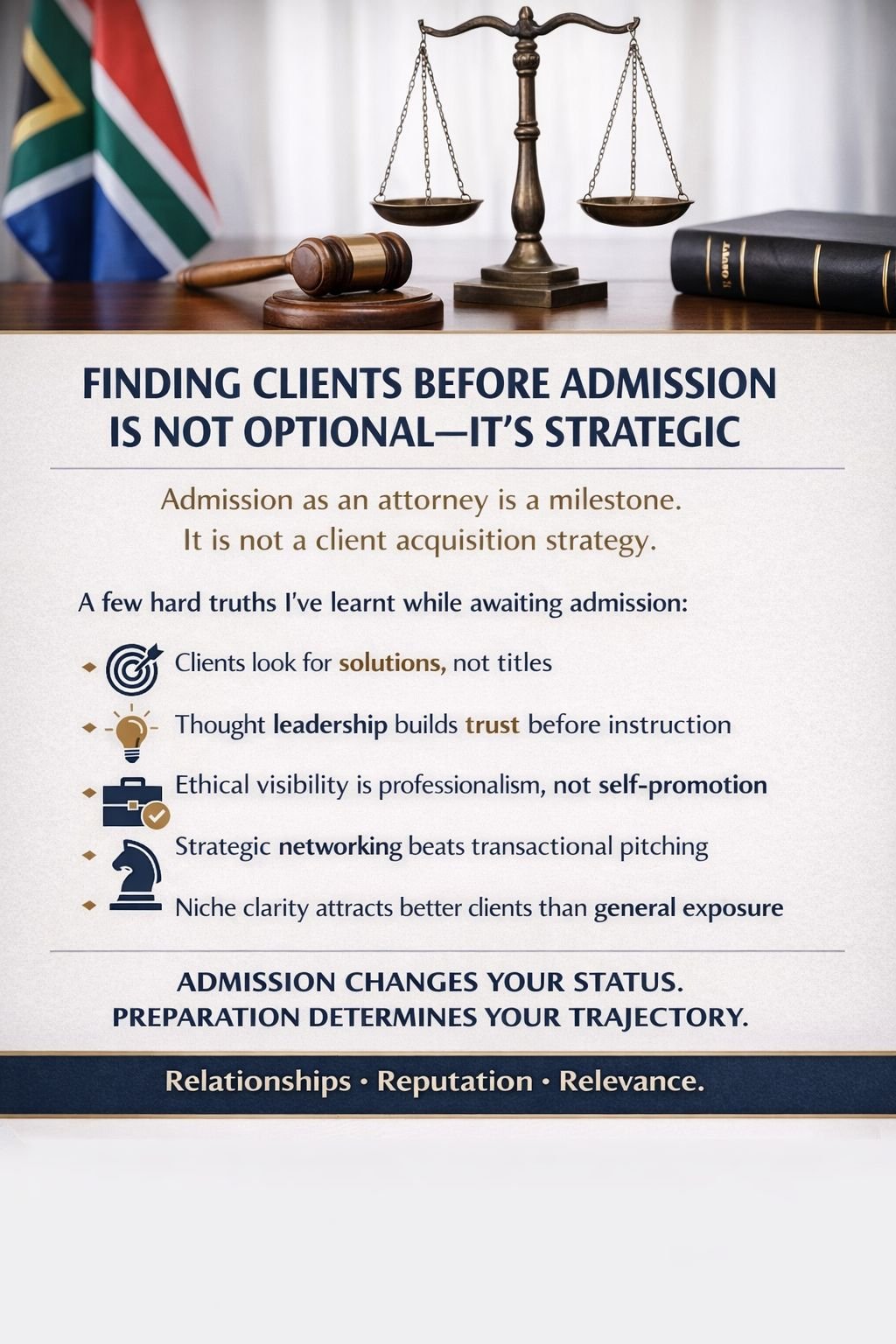
FINDING CLIENTS AS A LAWYER
Finding Admission as an attorney is a milestone, not a client acquisition strategy.
Too many early-career practitioners assume that clients arrive once their name appears on the roll. In reality, sustainable legal practices are built long before admission, through credibility, visibility, and relationships.
One of the biggest misconceptions in early legal practice is believing that clients arrive after your name appears on the roll.
In reality, sustainable practices are built before admission through credibility, visibility, and relationships.
A few hard truths I’ve learnt while awaiting admission:
• Clients look for solutions, not titles;
• Thought leadership builds trust before instruction;
• Ethical visibility is professionalism, not self-promotion;
• Strategic networking beats transactional pitching;
• Niche clarity attracts better clients than general exposure.
The pre-admission phase is a rare opportunity to define your professional voice, refine your focus, and build a pipeline rooted in reputation rather than desperation.
Admission changes your status.
Preparation determines your trajectory.
Too many early-career practitioners assume that clients arrive once their name appears on the roll. In reality, sustainable legal practices are built long before admission, through credibility, visibility, and relationships.
One of the biggest misconceptions in early legal practice is believing that clients arrive after your name appears on the roll.
In reality, sustainable practices are built before admission through credibility, visibility, and relationships.
A few hard truths I’ve learnt while awaiting admission:
• Clients look for solutions, not titles;
• Thought leadership builds trust before instruction;
• Ethical visibility is professionalism, not self-promotion;
• Strategic networking beats transactional pitching;
• Niche clarity attracts better clients than general exposure.
The pre-admission phase is a rare opportunity to define your professional voice, refine your focus, and build a pipeline rooted in reputation rather than desperation.
Admission changes your status.
Preparation determines your trajectory.
Blog
2026 starts with intention.
Strong governance.
Clear accountability.
Thoughtful decision-making.
This year isn’t about reacting to risk - it’s about anticipating it, understanding it, and building systems that support sustainable growth.
Here’s to a year of clarity, resilience, and progress!
Clear accountability.
Thoughtful decision-making.
This year isn’t about reacting to risk - it’s about anticipating it, understanding it, and building systems that support sustainable growth.
Here’s to a year of clarity, resilience, and progress!

Compliance is implementation
Client testimony :I once worked at a company where compliance existed purely as a checkbox exercise.
The policies were there.
The documents were there.
But the implementation wasn’t.
Processes were bypassed daily to achieve short-term goals, and accountability simply didn’t exist.
I raised the gaps early on. They were acknowledged - but never truly addressed. Most fixes were done “for appearances”, just enough to keep regulators satisfied on the surface.
That company no longer exists.
And the truth is, its downfall wasn’t sudden. It was inevitable.
When the tone from the top treats compliance as optional, that mindset filters through the entire organisation. There’s very little compliance can do to mitigate risk when leadership itself doesn’t believe in it.
The policies were there.
The documents were there.
But the implementation wasn’t.
Processes were bypassed daily to achieve short-term goals, and accountability simply didn’t exist.
I raised the gaps early on. They were acknowledged - but never truly addressed. Most fixes were done “for appearances”, just enough to keep regulators satisfied on the surface.
That company no longer exists.
And the truth is, its downfall wasn’t sudden. It was inevitable.
When the tone from the top treats compliance as optional, that mindset filters through the entire organisation. There’s very little compliance can do to mitigate risk when leadership itself doesn’t believe in it.
Why Lawyers can't Work From Home ?
Why Lawyers can't Work From Home ?
The Legal sector is on a significant shift.
Remote work is poised to redefine how Lawyers operate.
Consider these factors:
→ Technology is advancing rapidly.
→ Client expectations are evolving.
→ The benefits of remote work are becoming undeniable.
Here's what's changing:
✦ Enhanced Flexibility:
↳ Lawyers can manage their schedules more effectively.
✦ Reduced Overhead:
↳ Firms can save on office space and related costs.
✦ Wider Talent Pool:
↳ Firms can hire from anywhere, not just locally.
The traditional model is fading.
The future of Law is flexible, accessible, and efficient.
What this means for the industry:
→ Increased job satisfaction and reduced burnout.
→ Greater diversity and inclusion in the legal profession.
→ Improved work-life balance for legal professionals.
To prepare for this shift:
→ Invest in secure, cloud-based technology.
→ Develop clear remote work policies and guidelines.
→ Focus on outcomes rather than hours worked.
Are you ready for the future of Law?
hashtag#RemoteLaw hashtag#LegalTech
The Legal sector is on a significant shift.
Remote work is poised to redefine how Lawyers operate.
Consider these factors:
→ Technology is advancing rapidly.
→ Client expectations are evolving.
→ The benefits of remote work are becoming undeniable.
Here's what's changing:
✦ Enhanced Flexibility:
↳ Lawyers can manage their schedules more effectively.
✦ Reduced Overhead:
↳ Firms can save on office space and related costs.
✦ Wider Talent Pool:
↳ Firms can hire from anywhere, not just locally.
The traditional model is fading.
The future of Law is flexible, accessible, and efficient.
What this means for the industry:
→ Increased job satisfaction and reduced burnout.
→ Greater diversity and inclusion in the legal profession.
→ Improved work-life balance for legal professionals.
To prepare for this shift:
→ Invest in secure, cloud-based technology.
→ Develop clear remote work policies and guidelines.
→ Focus on outcomes rather than hours worked.
Are you ready for the future of Law?
hashtag#RemoteLaw hashtag#LegalTech
CAN you get fired for toilet roll in your bag?
FIRED AFTER TOILET ROLL FOUND IN BAG
April, employed by Mpact Operations as a Winder Operator since 2009, was dismissed in November 2022 after security found a roll of toilet paper in his bag during a routine search. The company alleged that the roll matched its unique brand and accused him of theft and dishonesty for attempting to remove company property without authorisation. April denied the allegation, stating he had brought the roll from home. The arbitration found his dismissal substantively unfair and ordered his reinstatement with back pay.
Mpact sought review of the arbitration award, contending that the arbitrator failed to consider that April knew of the workplace rule requiring declaration of personal items matching company property, failed to accept that the company’s toilet paper was uniquely sourced and not available in retail stores, and erred by preferring April’s version despite photographic evidence.
Security suspected April of theft based on a tip‑off, yet when a roll was found in his bag no effort was made to confiscate it, preserve it as evidence, or photograph it alongside the company’s own roll. The employer’s witness, Rall, took photographs only of the roll April allegedly brought from home, but not of the company roll on the day of the incident, offering an explanation described as nonsensical. Comparative photographs introduced later at the disciplinary hearing were of little evidentiary value because they did not reflect the original roll found on 21 October. The inconsistencies, omissions and failure to secure key physical evidence fundamentally compromised the employer’s case. Security personnel, including supervisory staff, allowed April to leave the premises with the disputed roll, undermining the allegation of attempted theft.
Without reliable evidence proving that the roll belonged to Mpact or that April intended to remove it dishonestly, the company failed to meet the required burden of proof. Mpact’s investigation was materially defective, its evidence insufficient, and the arbitrator reasonably found that the company had not proved theft, unauthorised possession, or dishonesty. The arbitrator did not commit any reviewable irregularity, and her decision was one a reasonable arbitrator could reach. The arbitrator’s preference for April’s version, and rejection of Mpact’s explanation, was reasonable in light of the flawed investigation and inadequate evidentiary record. The review application is dismissed.
Mpact Operations (Pty) Ltd v Metal and Engineering Bargaining Council and Others (C181/2024) [2026] ZALCCT 2 (15 January 2026)
April, employed by Mpact Operations as a Winder Operator since 2009, was dismissed in November 2022 after security found a roll of toilet paper in his bag during a routine search. The company alleged that the roll matched its unique brand and accused him of theft and dishonesty for attempting to remove company property without authorisation. April denied the allegation, stating he had brought the roll from home. The arbitration found his dismissal substantively unfair and ordered his reinstatement with back pay.
Mpact sought review of the arbitration award, contending that the arbitrator failed to consider that April knew of the workplace rule requiring declaration of personal items matching company property, failed to accept that the company’s toilet paper was uniquely sourced and not available in retail stores, and erred by preferring April’s version despite photographic evidence.
Security suspected April of theft based on a tip‑off, yet when a roll was found in his bag no effort was made to confiscate it, preserve it as evidence, or photograph it alongside the company’s own roll. The employer’s witness, Rall, took photographs only of the roll April allegedly brought from home, but not of the company roll on the day of the incident, offering an explanation described as nonsensical. Comparative photographs introduced later at the disciplinary hearing were of little evidentiary value because they did not reflect the original roll found on 21 October. The inconsistencies, omissions and failure to secure key physical evidence fundamentally compromised the employer’s case. Security personnel, including supervisory staff, allowed April to leave the premises with the disputed roll, undermining the allegation of attempted theft.
Without reliable evidence proving that the roll belonged to Mpact or that April intended to remove it dishonestly, the company failed to meet the required burden of proof. Mpact’s investigation was materially defective, its evidence insufficient, and the arbitrator reasonably found that the company had not proved theft, unauthorised possession, or dishonesty. The arbitrator did not commit any reviewable irregularity, and her decision was one a reasonable arbitrator could reach. The arbitrator’s preference for April’s version, and rejection of Mpact’s explanation, was reasonable in light of the flawed investigation and inadequate evidentiary record. The review application is dismissed.
Mpact Operations (Pty) Ltd v Metal and Engineering Bargaining Council and Others (C181/2024) [2026] ZALCCT 2 (15 January 2026)
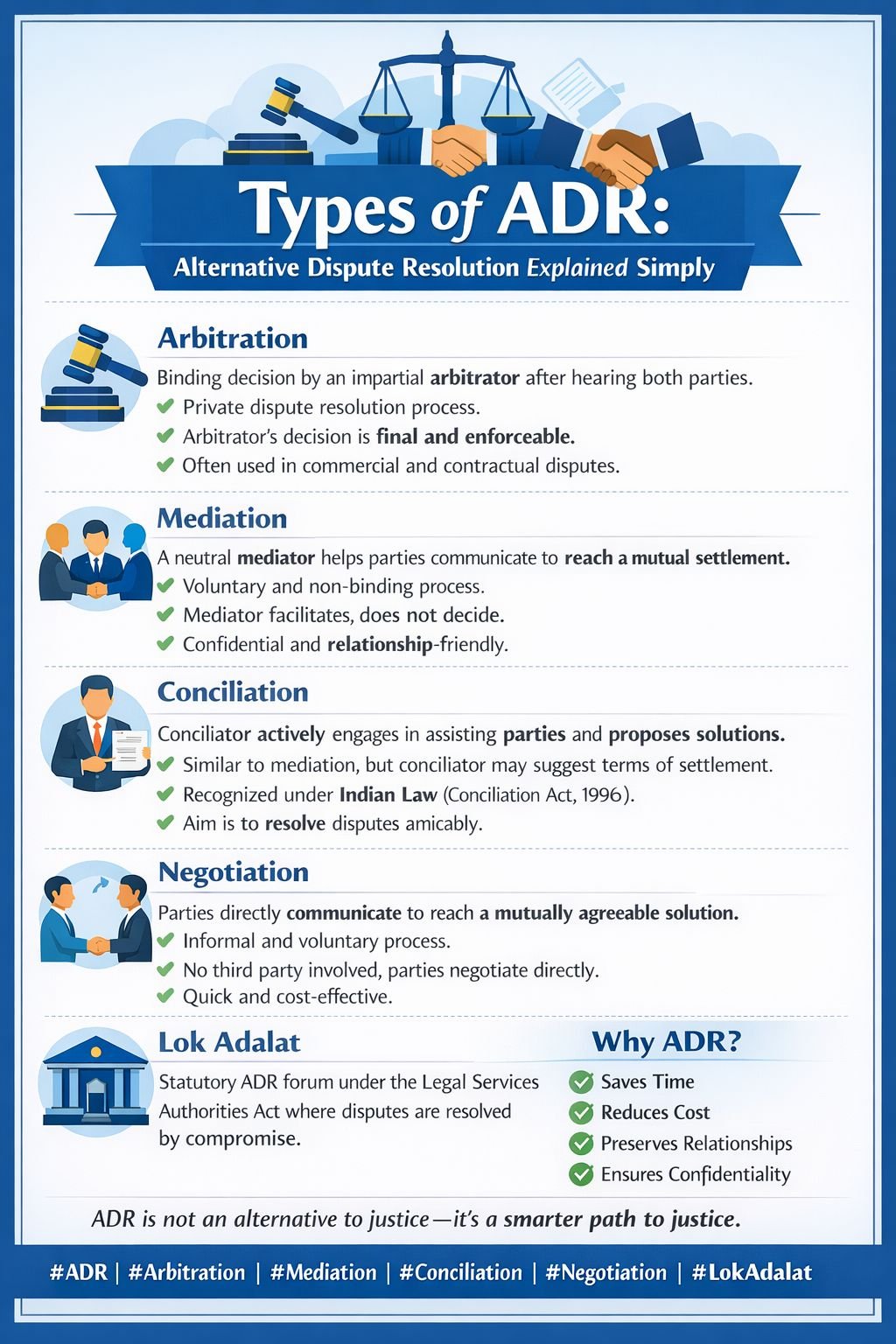
ALTERNATIVE DISPUTE RESOLUTION ADR EXPLAINED BY MUTHLIEY RAY AND ASSOCIATES
Alternative Dispute Resolution (ADR): Types Explained Simply
In today’s fast-paced legal environment, ADR mechanisms play a crucial role in resolving disputes efficiently, economically, and amicably—without prolonged court battles.
📌 Major Types of ADR:
1️⃣ Arbitration
A private dispute resolution process where an impartial arbitrator hears both parties and gives a binding decision.
✔ Common in commercial & contractual disputes.
2️⃣ Mediation
A neutral mediator facilitates discussion between parties to help them reach a mutual settlement.
✔ Voluntary, confidential & relationship-friendly.
3️⃣ Conciliation
Similar to mediation, but the conciliator may propose solutions.
✔ Recognized under Indian law (Conciliation Act, 1996).
4️⃣ Negotiation
An informal process where parties directly communicate to resolve disputes.
✔ No third party involved; fastest method.
5️⃣ Lok Adalat
A statutory ADR forum where disputes are settled through compromise.
✔ Awards are final and binding under the Legal Services Authorities Act.
⚖️ Why ADR?
✔ Saves time
✔ Reduces cost
✔ Preserves relationships
✔ Ensures confidentiality
📘 ADR is not an alternative to justice—it is a smarter path to justice.
hashtag#ADR hashtag#AlternativeDisputeResolution hashtag#Arbitration hashtag#Mediation hashtag#LegalAwareness hashtag#LawyersOfLinkedIn hashtag#JusticeSimplified
In today’s fast-paced legal environment, ADR mechanisms play a crucial role in resolving disputes efficiently, economically, and amicably—without prolonged court battles.
📌 Major Types of ADR:
1️⃣ Arbitration
A private dispute resolution process where an impartial arbitrator hears both parties and gives a binding decision.
✔ Common in commercial & contractual disputes.
2️⃣ Mediation
A neutral mediator facilitates discussion between parties to help them reach a mutual settlement.
✔ Voluntary, confidential & relationship-friendly.
3️⃣ Conciliation
Similar to mediation, but the conciliator may propose solutions.
✔ Recognized under Indian law (Conciliation Act, 1996).
4️⃣ Negotiation
An informal process where parties directly communicate to resolve disputes.
✔ No third party involved; fastest method.
5️⃣ Lok Adalat
A statutory ADR forum where disputes are settled through compromise.
✔ Awards are final and binding under the Legal Services Authorities Act.
⚖️ Why ADR?
✔ Saves time
✔ Reduces cost
✔ Preserves relationships
✔ Ensures confidentiality
📘 ADR is not an alternative to justice—it is a smarter path to justice.
hashtag#ADR hashtag#AlternativeDisputeResolution hashtag#Arbitration hashtag#Mediation hashtag#LegalAwareness hashtag#LawyersOfLinkedIn hashtag#JusticeSimplified
WHY GETTING THE PROCESS WRONG MAKES A DISMISSAL UNFAIR : LESSONS FROM THE LABOUR COURT
In PSA obo Van Wyk v Department of Social Development (2025), the Labour Court reaffirmed a fundamental principle of employment law:
fairness in dismissal depends as much on the process followed as on the outcome reached.
The employee, dismissed for unauthorised absenteeism, suffered from diagnosed alcohol dependence and depression. Despite this, the employer elected to pursue a misconduct process, rather than an incapacity enquiry.
The Court found this approach unreasonable and unfair. It held that:
• Alcoholism is a recognised form of incapacity, not misconduct;
• Absenteeism requires fault, which may be absent where conduct flows from medical incapacity; and
• Employers are required to comply with Schedule 8 of the LRA, including considering counselling, rehabilitation, and reasonable alternatives to dismissal.
The arbitrator’s failure to properly characterise the dispute and to engage with material medical evidence constituted a reviewable irregularity. As a result, the arbitration award was set aside and retrospective reinstatement was ordered.
Key lesson from the Labour Court:
Before deciding on discipline, employers must correctly identify the nature of the issue. Selecting the wrong process misconduct instead of incapacity undermines both substantive and procedural fairness.
This judgment serves as a reminder that lawful and credible workplace discipline requires accuracy, objectivity, and adherence to proper process.
hashtag#Employmentlaw hashtag#Proceduralfairness hashtag#Substantivefairness hashtag#Workplacediscipline hashtag#Fairnessattheworkplace
fairness in dismissal depends as much on the process followed as on the outcome reached.
The employee, dismissed for unauthorised absenteeism, suffered from diagnosed alcohol dependence and depression. Despite this, the employer elected to pursue a misconduct process, rather than an incapacity enquiry.
The Court found this approach unreasonable and unfair. It held that:
• Alcoholism is a recognised form of incapacity, not misconduct;
• Absenteeism requires fault, which may be absent where conduct flows from medical incapacity; and
• Employers are required to comply with Schedule 8 of the LRA, including considering counselling, rehabilitation, and reasonable alternatives to dismissal.
The arbitrator’s failure to properly characterise the dispute and to engage with material medical evidence constituted a reviewable irregularity. As a result, the arbitration award was set aside and retrospective reinstatement was ordered.
Key lesson from the Labour Court:
Before deciding on discipline, employers must correctly identify the nature of the issue. Selecting the wrong process misconduct instead of incapacity undermines both substantive and procedural fairness.
This judgment serves as a reminder that lawful and credible workplace discipline requires accuracy, objectivity, and adherence to proper process.
hashtag#Employmentlaw hashtag#Proceduralfairness hashtag#Substantivefairness hashtag#Workplacediscipline hashtag#Fairnessattheworkplace
SECOND WIVES AND THE LAW
Second Customary Marriages: Where Culture Meets the Law
A man who intends entering into a second customary marriage must appreciate that this is not merely a cultural progression, but a regulated legal process with serious proprietary and succession consequences.
In terms of the Recognition of Customary Marriages Act, a subsequent customary marriage requires prior court approval of a written matrimonial property contract. This contract must regulate the proprietary consequences of all existing and future marriages and protect the rights of the first spouse. An antenuptial contract signed privately, without court sanction, is legally insufficient.
Failure to comply does not only create uncertainty during the marriage, it almost invariably surfaces at divorce or death, where estates, surviving spouses, and children are left to litigate what should have been settled at inception. Proper planning must therefore align customary law, matrimonial property regimes, and succession planning as one cohesive exercise.
Need assistance? You may contact our office
A man who intends entering into a second customary marriage must appreciate that this is not merely a cultural progression, but a regulated legal process with serious proprietary and succession consequences.
In terms of the Recognition of Customary Marriages Act, a subsequent customary marriage requires prior court approval of a written matrimonial property contract. This contract must regulate the proprietary consequences of all existing and future marriages and protect the rights of the first spouse. An antenuptial contract signed privately, without court sanction, is legally insufficient.
Failure to comply does not only create uncertainty during the marriage, it almost invariably surfaces at divorce or death, where estates, surviving spouses, and children are left to litigate what should have been settled at inception. Proper planning must therefore align customary law, matrimonial property regimes, and succession planning as one cohesive exercise.
Need assistance? You may contact our office
Book a consultation with us for all Legal services
Tax Law Consulting, including tax structuring, compliance support, and advisory services;
Specialised Family Law and related advisory services;
Commercial & Corporate Law, including corporate due diligence;
Property Law Consulting, covering conveyancing transactions, rental housing law, and illegal land invasions;
Criminal Defence consulting;
General Civil Litigation advisory services;
POPIA & PAIA compliance, audits, and implementation support;
Labour Law & Comprehensive HR Consulting, tailored for operational and legal alignment;
Geopolitical analysis and strategic advisory services for NGOs, institutions, and government stakeholders.
Our firm reflects a commitment to strategic legal thinking, practical problem-solving, and measured advice informed by experience, not theory.
Specialised Family Law and related advisory services;
Commercial & Corporate Law, including corporate due diligence;
Property Law Consulting, covering conveyancing transactions, rental housing law, and illegal land invasions;
Criminal Defence consulting;
General Civil Litigation advisory services;
POPIA & PAIA compliance, audits, and implementation support;
Labour Law & Comprehensive HR Consulting, tailored for operational and legal alignment;
Geopolitical analysis and strategic advisory services for NGOs, institutions, and government stakeholders.
Our firm reflects a commitment to strategic legal thinking, practical problem-solving, and measured advice informed by experience, not theory.
2 WEEKS IN THE LIFE OF A CANDIDATE ATTORNEY
Week 2 as a Candidate Attorney
The pace has picked up as things normalise at the office.
Tips I can offer after week 2 as a Candidate Attorney:
Replacing the existing CA should be a well intentioned and guided exercise 🤝.
You’re not there as a threat but as a successor.
Even the existing CA must progress to year 2 - we are both growing on the SAME team ⚾️ - existing CAs please understand this.
Communication is the key to everything🗣️.
Whilst watching is a learning tool, you gain most knowledge through doing.
Always document what you’ve been tasked with📝.
Little notes on files help keep you on top of things 📌.
It’s easy to mix paperwork if you’re multi-tasking with physical files open simultaneously- DONT DO IT! ❌
Have some structure to your tasks for ease of flow and better management 🗃️.
It’s ok to to say “I didn’t know but now I do”.
Ask when you’re uncertain - if you must, remind everyone that you’re still learning.
You will get better with time. Don’t feel overwhelmed.
And remember, even the most experienced legal professional at the office was in your position at one stage 🙂✨
hashtag#CandidateAttorney hashtag#LegalTips hashtag#LawFirmLife hashtag#ArticlesOfClerkship hashtag#LegalCareer hashtag#TeamworkInLaw hashtag#ProfessionalGrowth
The pace has picked up as things normalise at the office.
Tips I can offer after week 2 as a Candidate Attorney:
Replacing the existing CA should be a well intentioned and guided exercise 🤝.
You’re not there as a threat but as a successor.
Even the existing CA must progress to year 2 - we are both growing on the SAME team ⚾️ - existing CAs please understand this.
Communication is the key to everything🗣️.
Whilst watching is a learning tool, you gain most knowledge through doing.
Always document what you’ve been tasked with📝.
Little notes on files help keep you on top of things 📌.
It’s easy to mix paperwork if you’re multi-tasking with physical files open simultaneously- DONT DO IT! ❌
Have some structure to your tasks for ease of flow and better management 🗃️.
It’s ok to to say “I didn’t know but now I do”.
Ask when you’re uncertain - if you must, remind everyone that you’re still learning.
You will get better with time. Don’t feel overwhelmed.
And remember, even the most experienced legal professional at the office was in your position at one stage 🙂✨
hashtag#CandidateAttorney hashtag#LegalTips hashtag#LawFirmLife hashtag#ArticlesOfClerkship hashtag#LegalCareer hashtag#TeamworkInLaw hashtag#ProfessionalGrowth